What Cultural Beliefs Affected the Production of Tribal Art?
Tribal art
What practice we define by 'Tribal Art' (also known as Ethnographic art) ?
As the name suggests, information technology is just that: art born from settled farmers and hunters; tribal communities that ofttimes had their ain autonomy and therefore their own characteristics. These arts, rooted in cultural context are governed past a set of rules that are every bit complex equally those that govern Western art forms.
Tribal African fine art is probably the hardest of all tribal art to interpret given that we are talking approximately 3 thousand ethnic groups spread out beyond an entire continent!
African tribal fine art
 Decorated knives
Zimbabwe and Congo
African tribal art consists of woods carvings, (masks and sculptures), rock carvings, furniture, ceramics, metalwork, jewelry, basketry, textiles, pipes, musical instruments, weapons, beadwork and the product of architectural features like doors and wall decoration and construction.
Non all of the tribes practiced all these art forms, the development of certain crafts existence due to the availability of raw materials, knowledge and skills. Wood was the about frequently used textile, often embellished by clay, pigments, shells, beads, ivory, metal, feathers, animal hair and raffia, and sometimes even semi-precious gems.
Particular cultures had item histories and item skills development and practice. Art was integrated into every aspect of life from formal ceremonies and religious rite to daily household tasks. It reflects the cycle of life; from birth, through initiation to adulthood, to expiry, to condign an ancestor.
The term 'tribal' may make usa recollect of an inferior form of fine art, associated with primitivism and thereby presuming lack of sophistication of skill, design, intent or concept.
Yet tribal art is enjoying more and more of the globe's attention as museums are re-evaluating and re-curating their collections in recognition of the fact that it is far from crude and archaic and very often shows a skill of execution that is way across what we expect. Information technology also has the power to make a connexion to our souls: Perhaps by their strong presence and their emotional dynamism, our inner instincts are brought to the surface and we connect with their veracity, nourishing our lack of something; a spiritual depth, a sense of something missing.
Tribal artifacts are indeed fascinating objects that have conjured up deep emotions not just for the tribal people for whom they were created but subsequently, also for the people who came into contact with these pieces.
Many of these artifacts left African shores in the 1800's when travelers and then missionaries, took them back to their own countries as objects of marvel. Non all of the emotions experienced were pleasant; fear, distaste, even repulsion and disgust. These feelings were more often than not evoked though a lack of comprehension on the office of the observer but information technology's not to say that becoming informed inverse one's perspective!
While one tin can possibly view this dispersion of African art in a disconsolate light, it has meant that these items have ended upward residing in countries where the rigors of harsh climate and termites have non afflicted them adversely.
Effectively they been preserved for united states of america to now capeesh and enjoy.
Within their own communities, since the artists themselves attached primary importance to the part for which they were created and non their aesthetic value, it meant that they were not venerated as pieces of 'fine art', with a budgetary value attached. In migratory tribes they also had to move with the seasons and suffered harm, were lost or abandoned.
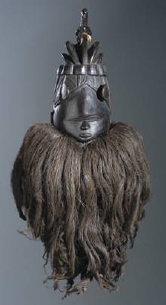 Ngumoi mask, Tribal art, Academy of Iowa
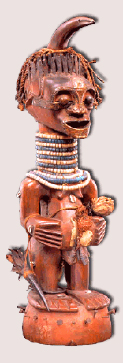 Singe nkishi sculpture
DRC Tervuren museum
Fully understanding tribal art from an observers' viewpoint demands a deep appreciation and cognition of Africa's history and cultural background. To know what one is looking at, to exist able to appreciate the innate qualities of that object upon which one is gazing, requires in-depth study and a desire to comprehend something that is generally out of our realm of feel.
Tribal etching is executed for a clear and specific function. A mask may be carved to be used by a shaman in a ritual ceremony or trip the light fantastic; a figure may stand for an ancestor or used to purposefully invite favour with the gods and spirits.
A post may be carved as a totem or as a contend mail or a prop for a master'due south house. A chair may exist intricately carved to stand for the authorisation of a chief or male monarch or a caput balance smoothed, rubbed and refined for a dark's sleep. A walking stick or pipage is given undue attention of detail and significance according to social calibration.
The more than dramatic and skillfully worked the piece can be fashioned, the purer information technology is in intent and the more information technology achieves its purpose of part.
The oldest sculptures and masks that exist today for observation were created in the belatedly 17th Century such equally those that reside in the Tervuren Museum in Belgium whose collection of Central African art numbers shut to 250 000 pieces of sculpture, masks and ceremonial furniture brought to Kingdom of belgium by regime officials and missionaries. Most of these pieces date from 1890 to 1940.
Historical tribal areas
- Sudan - Bongo
- Federal democratic republic of ethiopia - Ababa, Addis
- Somalia - Merca
- Western Sudan and the Guinea Coast
- Dogon tribe of key Mali
- Bambara of W Republic of mali
- Baga of NW Guinea
- Poro, Dan of Liberia
- Baule, Guru, Senufo of Cote D'Ivoire (the Ivory coast)
- Ashanti, Dahomey of Republic of ghana
- Nigeria - Nok, Yoruba, Republic of benin
- Igbo, Ibibio, Ekoi and Ijaw of SE Nigeria
- Cameroon and Gabon - Mangbetu, Bakota
- Republic of Congo Kongo
- Bateke, Bapende of W Congo
- Bembe, Bushongo, Basonge of Central Congo
- Baluba of SE Congo
- Chokwe of Due south Congo
- Zaire and Angola - Luba, Songwe, Hemba
- Angola - Katanga
- Kenya - Kamba, Giriama, Turkana
- Tanzania - Jiji, Makonde, Maasai, Mbulu
- Mozambique - Makonde, Chemba, Bisa, Noyonanyonga
- S Africa - Zulu, Nguni, Tembu, Shangaan
- Zambia - Rotse, Lozi, Tonga
- Republic of zimbabwe - Shona, Ndebele, Venda, Shangaan, Tonga
- Namibia - Herero, Yei, Himba
Modern African Tribal Art
In modern terms, tribal art is difficult to qualify as such because while a contemporary African artist may acknowledge his tribal roots and pay fidelity to information technology, very frequently he/she may no longer alive in an isolated, self-directed customs situation simply rather has become office of modern day society, frequently living either abroad or in urban societies.
Contemporary African artists often use aesthetic grade to limited a societal comment on the impact of urbanization and globalization on their culture. Their art can reflect this while still assimilating traditional skills and tribal civilisation and beliefs into their work.
Lamidi Olonade Fakeye, Nigeria, 1925, died Xmas 2009.
An eminent and celebrated artist whose middle name 'Olonade' means 'the chief artist is amid united states of america' or simply 'the carver is here', depending on whether 1 sees him in an elevated condition or not.
Either way, Fakeye is internationally recognized for being a carver who is a modernistic primary of the ancient Yoruba tradition of ONA wood carving.
He produced his first piece at 10 and thereafter bought an imperial quality to his creations which spoke volumes most the culture of his tribe and all its myths and sociology.
Sometimes styled in solid panels, in relief or in figurines and working in his preferred medium of iroko forest, he had detail themes he developed; Oduduwa, Olumeye and House Posts.
His work was also often used as part of architectural aesthetics in the tradition of decorating palaces, public institutions and homes of the elite who recognized the sustainability and value of the continued exercise of majestic wood etching.
jenningswrowspent.blogspot.com
Source: https://www.contemporary-african-art.com/tribal-art.html

Post a Comment for "What Cultural Beliefs Affected the Production of Tribal Art?"